
How to Get Court Records
Start by naming the right court. Sixth District Court clerk staff keep the Sevier County District civil, domestic, criminal, probate, judgment, and related records. Justice Court staff hold the county's traffic, misdemeanor, infraction, ordinance, and small-claims files. Juvenile Court handles juvenile records, which are generally closed to the public. The County Clerk/Auditor does not keep state court files.
- Search Xchange and confirm the case number, court, document description, and filing date.
- Buy a linked public image online, or call District Court at 435-896-2700 or Justice Court at 435-893-0461.
- Ask about counter pickup, mail delivery, email or fax service, payment, and whether a plain or certified copy is needed.
- For a missing or older item, submit the official Request for Court Record form under Utah court-record access rules.
- Use the court reporter or court's stated process for transcripts and audio or video proceedings.
Three Sevier County Record Products
Sevier County offers three distinct record products. They are not interchangeable. A case history is the quickest way to trace events and settings. A filed document gives you the actual text of a motion, order, complaint, or judgment. A certified copy carries the clerk's certification for official use.
| Product | What it provides | How to obtain it |
|---|---|---|
| Case history | Chronological public events and settings | Xchange or public terminal |
| Filed document | The public image behind an entry | Xchange link or court clerk |
| Certified copy | Clerk-certified document or judgment | The court holding the original file |
A browser printout is not certified. Before you pay for anything, ask the receiving office which form it actually needs.
Types of Court Records
Public Sevier County court records can include case histories, complaints, answers, motions, orders, and judgments. Probate papers and public financial entries appear as well. Criminal files may show charges, pleas, settings, and dispositions. Civil and domestic matters can mix public entries with private filings. What the public may inspect depends on the category and classification of each record.
- District criminal, civil, domestic, probate, guardianship, conservatorship, name-change, and judgment files
- Justice Court traffic, infraction, misdemeanor, ordinance, and small-claims files
- Filed orders and judgments available as public images or clerk copies
- Public hearing records, with transcripts and recordings handled through a separate production channel
- Restricted files available only through an authorized access decision
The public register can stay visible even when one attached filing is private. Access has to be checked document by document.
Sevier County Record Request Fallback
Xchange may hold no image of a Sevier County case file. Or the record may simply be older than what the system holds. There is a formal backup. Utah Courts publishes a Request for Court Record process for exactly that situation. Any member of the public may ask for a court record this way. The court itself aims to respond within ten business days. Staff can arrange payment for copying, retrieval, or research time if those charges apply.
The Utah Courts page on record requests spells out the steps. It also covers what to include when you submit one.
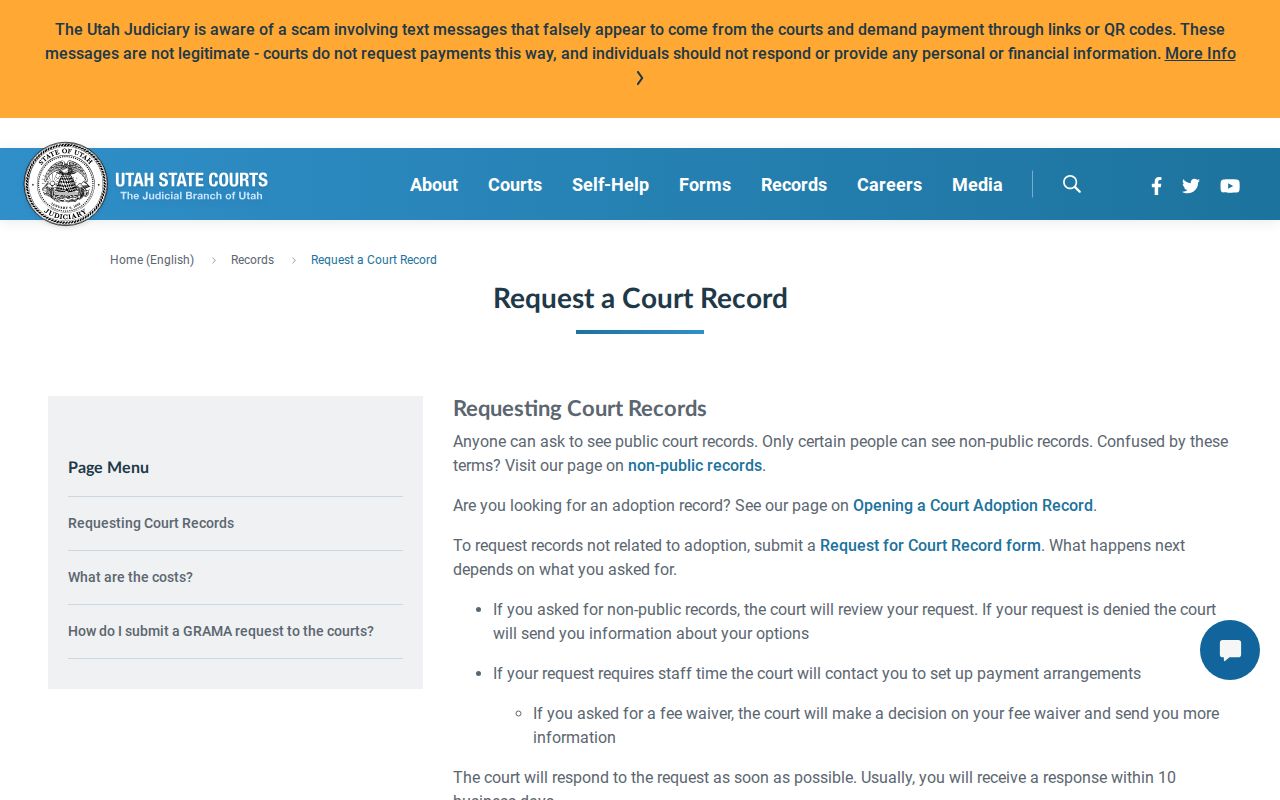
Fill out the official form as published. If a field label is unclear, do not guess it onto a homemade form.
What a Court Record Contains
A Sevier County file has two parts. One is a case header, and the other is a stream of filings and court events. Read the case number, court, case type, caption, and party roles first. Then tell the short event description apart from the document itself. A docket entry may say a motion was filed. That entry does not give you the motion's full text. Nor does it prove the claim inside that motion.
| Case header | Court, case number, type, caption, filing date, and status. |
|---|---|
| Parties | Names, role codes, and attorneys when recorded and public. |
| Pleadings | Petitions, complaints, answers, motions, and responses. |
| Orders and judgments | Signed rulings and final or post-judgment documents. |
| Case history | Chronological filings, settings, payments, and outcomes. |
| Exhibits | Filed material only when its classification permits access. |
Sevier County Electronic Records
Public District Court documents filed electronically since July 1, 2010 may sit in Xchange. The case history and the image are separate clicks. Older converted Justice Court records can hold less detail, and an old paper file may need clerk retrieval. A missing document link does not mean the document does not exist. Write down the exact document title and date. Then ask the holding court for it. The clerk can explain delivery and payment. For a file the counter cannot hand over, a formal request fits the job.
Certified Copies and Fees
A plain copy simply reproduces the record. A certified copy adds the clerk's certification, and an exemplified copy provides a higher form of authentication. Confirm which form the receiving office requires before you order.
| Item | Amount |
|---|---|
| Plain paper copy | $0.25 per sheet |
| Certified copy | $4 per document plus $0.50 per page |
| Exemplified copy | $6 per document plus $0.50 per page |
| Electronic media | $15 per unit |
| Audio or video | $15 per half-day of testimony |
Sixth District Court Clerk Staff
845 East 300 North
Richfield, UT 84701
435-896-2700
Sevier County Justice Court
250 North Main, Suite 124
Richfield, UT 84701
435-893-0461
Sevier County Record Staff Charges
The first 15 minutes of staff work are free. Utah then lists $15 per hour for clerk time, $21.20 for a judicial assistant, $28.70 for a service-desk technician, $37 for a manager, $45 for a data analyst, $100 for a programmer, and actual cost for a consultant. Courts should use the least costly qualified worker. The current fee guidance from Utah Courts spells out each rate.
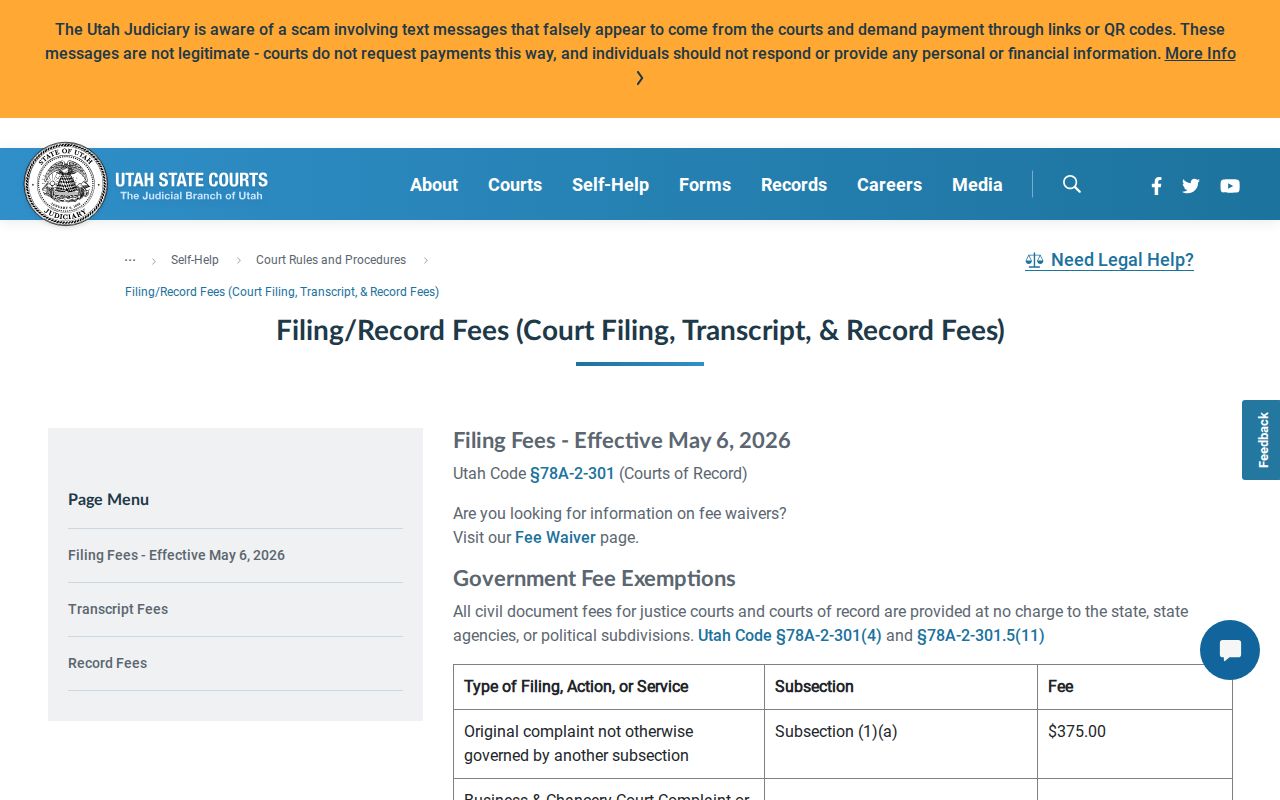
A precise case number, date, and document name can cut search and retrieval work. The court may also address a fee-waiver request under its own process.
Sevier County Hearing Records
A transcript is not a routine clerk copy. Ask the reporter or the court for the right production channel. Utah lists initial transcript preparation or a certified copy at $6 per page. A later certified copy runs $0.50 per page plus a $4.50 certificate. A later non-certified copy is $0.25 per page. Audio or video proceedings carry a separate $15 per half-day fee. Know the hearing date, judge, court, and case number before you call. A docket entry shows that a hearing was set or held. It does not contain the spoken testimony.
Public Access and Sealed Records
Utah court files may be public, private, protected, sealed, or otherwise restricted. A public hearing does not make every filing public. Juvenile, adoption, expunged, sealed, medical, and protected material may be missing or redacted. Seek authorized access from the holding court itself.
Key Utah court-record rules:
UCJA Rule 4-202.02 classifies court records.
UCJA Rule 4-202.03 governs access to each class.
UCJA Rule 4-202.04 provides the request path for access and classification decisions.
Sevier County Record Custodians
The Sevier County Clerk/Auditor handles county-government work, not Sixth District case files. Send District record requests to the Sixth District clerk. Send Justice Court requests to the Justice Court clerk. The caption, citation, or Xchange header tells you which court holds the file. Driver records belong to the Utah Driver License Division instead. Reporter material goes through the transcript channel. A court-record request should name the judicial file. It should not name some separate government record tied to the same event.
Certified Sevier County Court Records
A judgment heading to another court has to meet that court's authentication rule. Check the rule first. Then find the judgment in Xchange and jot down its date and title. Call the clerk who holds the Sevier County file. Ask whether the other court wants a certified copy or an exemplified one, and how payment and delivery are handled.
Statewide materials list no Sevier-specific search fee. They list no universal ID rule and no fixed mail turnaround for certified copies. The clerk sets those details. Treat the general ten-business-day response statement as a guide, not a guarantee for every archived or certified order.
Once the copy arrives, keep the receipt. Also keep the clerk's description of the certified item. Certification covers only the document supplied. It does not vouch for every event in the case history. A quick label with the court and case number keeps the Sevier County court record easy to match later.
Older Sevier County Court Records
Older justice cases that were converted for Xchange may show less detail than newer Sevier County court records. The record still exists. A thin online history only means the docket search came up light. The court record is not off limits.
Start by confirming the court and the case number. Ask the proper clerk whether a paper file or archived version sits in storage. When the online history lacks what you need, use the official Request for Court Record process. The Utah request page says the court generally responds within ten business days. Retrieval, staff work, copying, and delivery can all affect cost and timing.
Statewide coverage material echoes the same caution about converted justice records being less complete. A short docket entry should push you toward a clerk inquiry. Do not guess that nothing else exists. Give the clerk the party names. Add the likely filing year, the case type, and the title of the document you want. Those details help the clerk. The clerk can then tell an archived paper file apart from a sealed or otherwise nonpublic record.